The quality of your relationships determines the quality of your life. — Esther Perel
I asked my friend to test our game with her boyfriend, and she happily agreed. The next day, she casually mentioned that they had played. I asked how it went, hoping to hear a couple of fascinating romantic discoveries.
She said it was fine.
I felt disappointed and thought it just didn't resonate. It happens. At least she didn't say it was openly boring.
Later, I found out they had rushed through it like a romantic sprint. In just a couple of hours, they answered all 150 questions from all five levels. "Interesting," I thought. They took my advice to play at their own comfortable pace literally. Of course, it turns into a rapid-fire quiz of questions and answers — impossible to truly hear each other, let alone feel feelings. Competition instead of the romantic spark that my husband and I carefully created for ourselves and for other people who also love spending meaningful time together.
We default to conflict mode
What's interesting is this: we constantly do all of this in conflict mode. We talk in conflict mode. We "work things out," passionately defend our own rightness, and masterfully prove our partner wrong. We do it with taste and enthusiasm, slowly, fully living through and digesting every feeling.
But what if we switched from conflict mode to connection mode? Talking and listening to each other on a date. Exclaiming and gasping with joy and surprise. Playing and flirting with excitement.
Seriously. I've been there. I'm sure many people know this experience — those serious relationships where all the romance is decided by buying a new refrigerator, glasses, or a car. Whether the child will go to private school or public school. Whether to buy or rent a home. Which parents to spend Christmas with.
You're late again. Dinner is wrong again. Leave me alone, I'm working. Again.
In that experience, beautiful, precious, and deeply good intentions drown and choke in a puddle of everyday life. No one hears anyone. In time, no one even seems to need anyone anymore. Everyone is focused on reaching the goal and so tired that they're simply glad to lean harder, more firmly, on their partner's shoulder. There is no room left for the beauty of loving feelings.
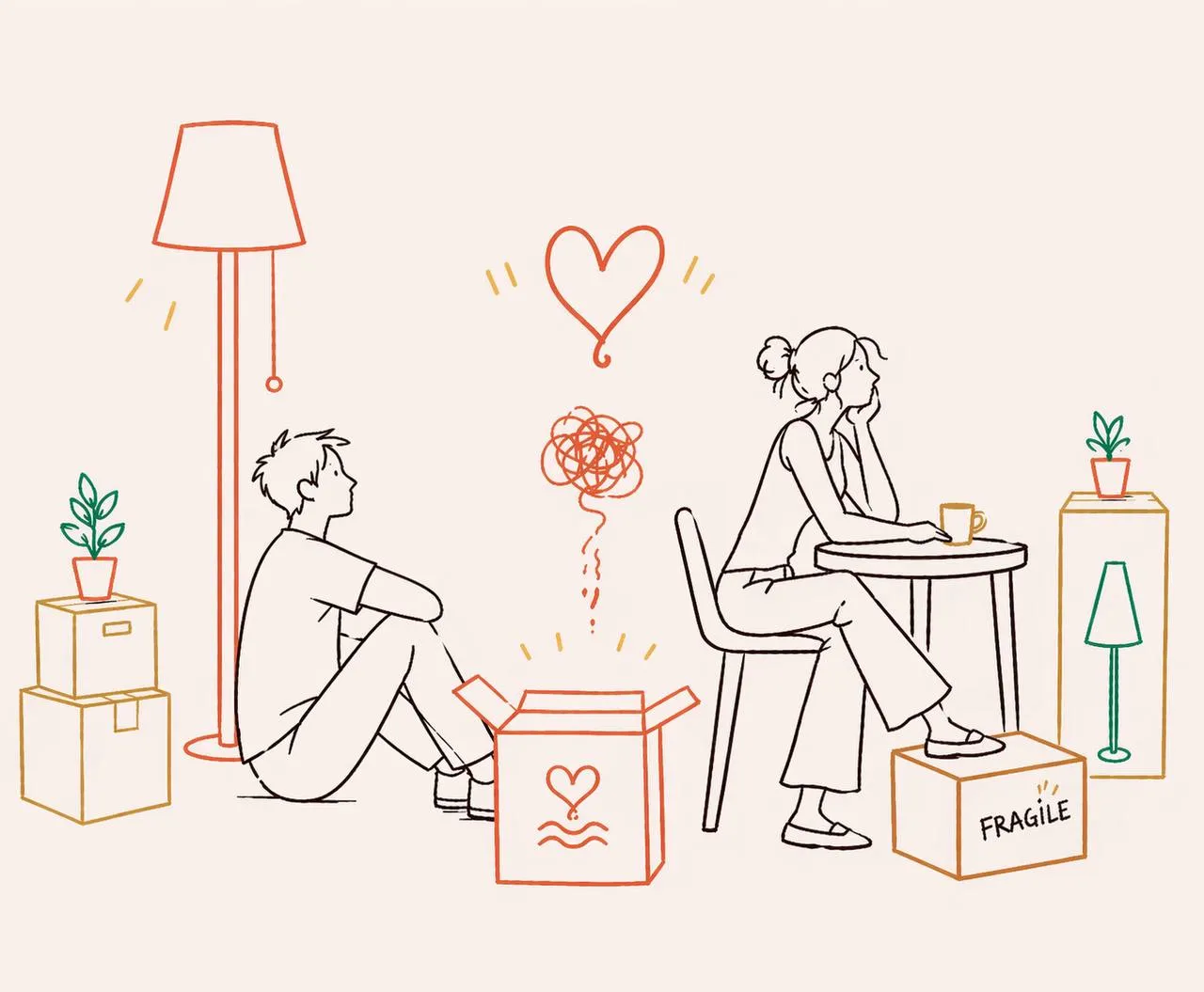
Looking in the same direction
"So what, you just sit here and look at each other?" our neighbor asked when she came by to chat.
"Well, yes," I answered with a laugh, though inwardly surprised by the question. Then I asked curiously, "And you? Don't you?"
"Well, yes, of course," she said. "We used to. When we were dating."
To love does not mean to look at each other, but to look together in the same direction. — Antoine de Saint-Exupéry
I apply it to myself. Yes — goals and plans, daily life and priorities, tastes and interests, all in one direction. Fair enough.
But I love romance. Very much. All those conversations of "I love you so much," the little things through which we feel care, warm looks, and hot kisses.
I try to imagine myself without it. Honestly, without that — without romantic endorphins and adrenaline, without knowing that I am seen and heard by my person — I would lose desire. An important desire: to stand shoulder to shoulder, back to back, to look in one direction with this particular person. I don't want dates, conversations, and romance to be left in last place on the list of priorities.
Small things often
Small things often. — John Gottman
Small things make up our lives. Practical things make practical life. Loving things make love.
I no longer want to be married to a partner in buying furniture. Furniture matters. I just want to buy it with the partner I deeply love — after one of many romantically spent evenings.
The same John Gottman said:
Love maps are built from knowing your partner's inner world.
For me, a pleasant and soulful way to know my partner's inner world is to play. To play with questions and answers — because it is a safe way to ask and to answer. To play at organizing fun dates. To play at inventing games.
Try it — just remember this
- Sometimes one question gives more than twenty.
- You don't have to move on to the next card if a real conversation has begun. The cards are already yours — you can come back later. It's much harder to bring back an important feeling.
- Feel the moment, not the pace.
- Value an honest answer. It means you are trusted, and that matters far more than beautiful words.
- Beauty can be found in a smile, a hesitation, a glance.
- Be surprised — even a familiar person changes.
- Laugh. It brings people closer.
- If you suddenly want to hug, talk about something else, go for a walk, or kiss — drop the game. You've reached the goal for today.